HIRING | 8 min | May 12, 2026
The 8 AI roles every team actually needs in 2026
A practical breakdown of the disciplines AI products depend on - and which one to hire first depending on where you are stuck.
By Devlyn
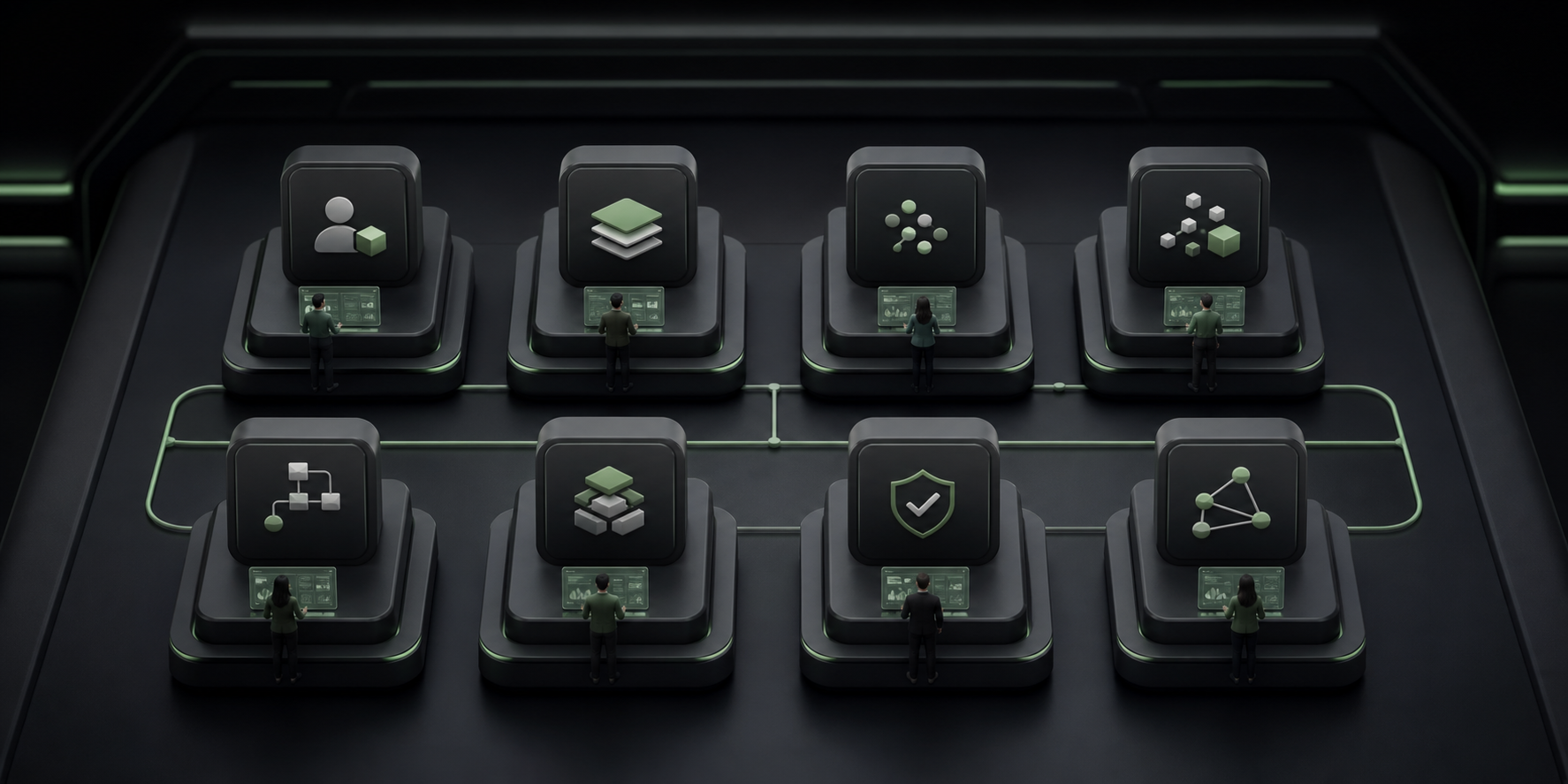
“AI engineer” stopped being one job around the time shipping an LLM feature started touching retrieval, evals, agents, inference economics and a brand-new security surface. Here are the eight disciplines an AI product genuinely can’t ship without - and how to know which one you need first.
Direct answer: The eight AI roles a serious product team needs are Forward-Deployed AI Engineer, AI Application Engineer, LLM Engineer, RAG & Context Engineer, Agentic Workflow Engineer, AI Platform Engineer, AI Security Engineer and Data Scientist. Each role maps to a different failure mode in production AI.
The eight roles
- Forward-Deployed AI Engineer - owns features end to end, embedded in your team.
- AI Application Engineer - builds the product layer: streaming UIs, tool calls, structured outputs.
- LLM Engineer - owns the model layer: evals, prompts, routing, fine-tuning, inference cost.
- RAG & Context Engineer - makes the model answer from your data, accurately.
- Agentic Workflow Engineer - multi-step agents that use tools and survive production.
- AI Platform Engineer - serving, gateways, GPUs and the rails that make AI reliable.
- AI Security Engineer - defends against prompt injection, leakage and model abuse.
- Data Scientist - turns data into decisions, so you know whether any of it worked.
Which to hire first
- Stuck between demo and shipped? Start with a forward-deployed engineer.
- Model works, product does not exist? Hire an application engineer.
- Confident but wrong answers? Hire a RAG and context engineer.
- Prompts sprawling, quality drifting? Hire an LLM engineer.
- Single prompt no longer enough? Hire an agentic workflow engineer.
- Cost climbing, deploys scary? Hire an AI platform engineer.
- AI touches sensitive data or actions? Hire an AI security engineer.
- Betting on instinct, not evidence? Hire a data scientist.
The wrong first hire is expensive because AI failures compound. A product engineer can build a beautiful assistant on top of weak retrieval. An LLM specialist can tune prompts for a workflow that still has no product adoption. A platform engineer can make inference cheaper before the team has proven the use case. Start with the bottleneck, not the title that sounds most senior.
Role-to-problem map
| Buyer problem | Best first role | Why |
|---|---|---|
| “We have AI ideas but no owner” | Forward-Deployed AI Engineer | Owns the full arc from ambiguity to shipped feature |
| “The model works but the app does not” | AI Application Engineer | Builds the product layer around the model |
| “Quality changes and nobody can prove why” | LLM Engineer | Creates evals, prompt systems and routing discipline |
| “The assistant answers from the wrong source” | RAG & Context Engineer | Measures retrieval and improves grounding |
| “The workflow needs tools and multiple steps” | Agentic Workflow Engineer | Designs state, permissions, recovery and handoff |
| “Latency and cost are becoming a platform issue” | AI Platform Engineer | Owns gateways, serving, observability and cost controls |
| “AI touches sensitive data or actions” | AI Security Engineer | Threat-models injection, leakage and abuse |
| “We do not know whether the feature worked” | Data Scientist | Builds measurement, experiments and decision support |
Why exactly eight
Add a ninth generalist and the focus blurs. Drop one and a real team feels the gap. Eight is the smallest set that covers how AI actually gets built - so eight is what we staff.
The list is not meant to describe a giant team every company hires at once. It is a vocabulary for making the next hire precise. A startup might begin with one forward-deployed engineer and add RAG depth later. A scale-up with several AI features may need platform and security before it builds more product surface. An enterprise team may need data science first because the business case is still unproven.
That is the real value of splitting the roles. The buyer stops asking for a generic “AI engineer” and starts asking for the capability that removes the current blocker. Better hiring starts with a cleaner role definition.